Author: Journal of Baphomet

  • Hands Inside the River

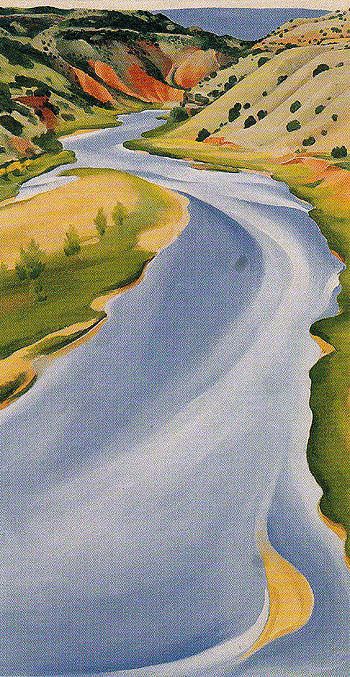
    Georgia O’Keeffe, 1937

    A reflection on what it means to mother, to grieve, to fish, and to feel death not as absence but as sacred presence.

    I never thought motherhood would find me. Not in the way people imagine with cribs and lullabies and baby showers. But it showed up in my body and in the way I loved. It showed up in how I listened. In how I held grief like it was something small and breathing. I’ve been the one to feed others when I was hungry. I’ve learned the shape of safety by being the one who builds it. I’ve wiped tears from the faces of people who didn’t know how to say thank you and still I stayed. I’ve looked at the world with the kind of softness that gets mistaken for weakness but is anything but. That softness has teeth when it needs to.

    That evening was like any other. Quiet. I needed the water more than I needed answers. I didn’t plan to catch anything important. Just wanted stillness. The kind of stillness that teaches you how to breathe again. The river was slow and shining and I felt myself return to something old. Something wordless. When the line tugged it felt different. Like being chosen. I reeled her in slowly. She wasn’t thrashing. Just weight and breath and river muscle. When I lifted her from the water I felt it right away. Something in me stirred. I could feel her body before I even really saw her. I knew she was a mother. I don’t know how I knew. I just did.

    She was thick with life. Her belly was full in a way that made my hands tremble. I didn’t want to touch her there. I didn’t want to disturb what she carried. I could feel it without pressure. Her ovaries held something ancient and sacred and I felt like I was intruding. There was awe in that moment. And fear. Not of her but of what it meant to be holding her. I’ve been that full before. With hope. With pain. With things I couldn’t name but still carried.

    I took her home. I didn’t want to kill her. Not in the cruel way. But I knew the story had already started. I had already stepped into it. My wife stood on the porch, the light catching her hair, silent like she always is when something holy is happening. I laid the fish down gently. I met her eyes and there was nothing there but I felt seen. I held the blade for a long time before I moved. When I finally did I went slow. Careful. And when I opened her belly the eggs spilled out like pearls and yolk and memory. So many. More than I could count. Bright and wet and unreal. It took my breath.

    That’s what death feels like sometimes. Not violence or absence, but unbearable fullness. Like swinging too high and knowing you can’t take it back. Like saying goodbye but running out of time. Like holding your breath too long in silence that once felt safe. Death isn’t always loud. Sometimes it spills gently across a cutting board while your hands try to make sense of what they’ve done.

    I stood there with my hands inside her and time stopped. I felt like I was reaching into the belly of the river itself. I didn’t cry but I think my soul did. I didn’t feel proud. I didn’t feel sorry. I felt everything. That fish would have eaten countless salmon and steelhead juveniles like it already had been doing for years. She would have taken futures into her mouth without pause. But she was still a mother. A giver. A taker. A piece of the whole. I had interrupted that. And yet I had honored it too.

    My wife placed a hand on my back. It was the smallest touch but it steadied me. We finished gutting her together in silence. We kept the meat for crab bait. Let the eggs return to the earth. I whispered something I can’t remember now but I know it was true. I know it came from the part of me that understands sacrifice. The part that knows not all mothers give birth. Some of us just hold space. Some of us know life even when it slips through our hands.

    That night I sat with the smell of river on my skin and thought about the way I knew. The way I could feel the life inside her before I ever cut her open. That wasn’t science. That was spirit. That was the thread that ties us to the water and the soil and the dark. That was the kind of knowing you don’t get from books or facts or names. It lives in your hands. It lives in the silence after. And it waits. It waits for those of us who are brave enough to feel it.

    That was the day I caught a two and a half pound northern pikeminnow and met something divine. Not because I conquered her but because I saw her. Because I felt her. Because I recognized the weight of her body in a way I have only ever recognized my own. That was the day I understood that to mother is not just to birth. It is to bear witness. To take life and give it back. To know when to hold and when to let go. That was the day I learned I am more river than anything else.

  • Glitter Don’t Make You Good

    Ophelia by John Everett Millais

    you liked my grief like it fed your mood
    heartin’ my wounds like they tasted good
    scrollin’ for depth you never earned
    you spoke of healing, then watched it burn

    you call me “buddy” like I’m some joke
    soft voice sharp tone wrapped in smoke
    sayin’ “trans” like it’s glittered gold
    but you only want shine not the weight it holds

    you pointed at her when the cracks began
    but kept cashing love from the same old hand
    you held on tight like pain was proof
    and kept her close like grief was truth

    you said “she owes me” like trauma’s rent
    like pain’s a bill that still ain’t spent
    you followed a map that never was yours
    tied up the cracks and called them cures

    you speak of truth but play a part
    to dress up damage and hide the rage
    you touch queer air but don’t breathe in
    you skirt the dark then call it peace
    you missed the sacred when you left the room
    we hold each other like full-bloomed truth

    you wear your hurt like a crown of glass
    but never look inward never ask
    who you’ve used who you’ve bruised
    who you’ve pushed and excused

    glitter don’t make you good
    don’t cleanse the rot don’t mean you should
    play saint in sequins soft and cruel
    love ain’t performance and I’m no fool

    so keep your likes your coded posts
    your name-dropped queers your haunted ghosts
    you don’t get me not even a bit
    this is closure, I’ve left what you wrote

  • “What is Social Construction?”

    Teaching Tolerance by Olaf Hajek, 2013

    In “What is Social Construction?” Paul A. Boghossian breaks down what it really means when we say something is “socially constructed,” and pushes back on the way that idea has sometimes been stretched too far. At its root, calling something socially constructed means it exists because of human decisions, values, and systems, it didn’t have to exist, and it could have been built differently. Examples like money, laws, and gender roles are used to show how some things are clearly created through social processes, not natural ones. Boghossian separates two important types of social construction: the construction of things and the construction of beliefs. A socially constructed thing (like citizenship) only exists because we collectively agree it does. On the other hand, a socially constructed belief refers to when we hold certain views not purely because of evidence, but because of the role that belief plays in our society. For instance, the belief in strict gender binaries can serve particular social functions, but that doesn’t make it objectively true. The concern Boghossian raises is when people apply social construction too broadly, especially to things in natural science. He argues it doesn’t make sense to say that dinosaurs or quarks are socially constructed, they existed (or didn’t) whether humans were around to believe in them or not. He also critiques the idea that scientific knowledge is just a reflection of cultural values. Yes, science is done by people, and our interests influence what gets studied and how, but Boghossian emphasizes that claims still have to be backed by evidence. That distinction really matters. He warns that if we reject objectivity entirely, we risk making it impossible to challenge harmful beliefs with reason, and we lose any shared foundation for fighting injustice. Reading Boghossian’s critique, I found myself thinking about how these ideas intersect with my own life as a trans person, someone whose existence is often debated in terms of both biology and social meaning. It made me reflect on the ways I’ve personally navigated questions of what’s constructed, what’s real, and what feels deeply, undeniably true.

    As a trans person, I see a lot of value in social construction as a way to name and challenge oppressive systems, especially around gender, race, and disability. I don’t believe everything is biologically fixed, and I think our categories often reflect power more than truth. But I also believe in evidence and the importance of shared reality. What I appreciated about this reading was how Boghossian encouraged a more careful use of the idea, he didn’t reject social construction altogether, but reminded me that just because something has social meaning doesn’t mean it’s not also tied to material or biological realities. That balance is something I care about in my own politics, especially when advocating for both recognition and material safety for trans people. At the same time, I also believe in intuition, inner knowing, and emotional truth, things that can’t always be measured or explained through physical evidence. I understand that I am biologically female by the standard definition based on physical sex characteristics. But there is also a deep part of me that transcends my physical form. I’m not just a body or a figure. I’ve had to reflect over time on what parts of me were shaped by society, what parts I rejected to survive, and what parts feel like they’ve always been mine. When I first came out as a trans man, I wanted nothing to do with anything that reminded me of being female. I had spent 18 years being forced to be a girl, getting periods, wearing long hair, dressing in clothes that didn’t reflect me. My first response, after finally gaining independence, was to reject it all. But over time, I realized I don’t reject those parts of myself anymore. They’re part of my story. That doesn’t make me less of a man. I still show up in the world as a man. My legal documents say male. I’m listed for the draft. Nothing about that changed, but how I relate to myself has grown deeper and more honest. Social construction is useful, but it’s not the whole picture. There’s also the quiet, persistent truth of who I am.

    References:
    Boghossian, Paul. “What Is Social Construction?” Times Literary Supplement, 23 May 2005, pp. 6–8.

  • The Cicadas Kept Screaming

    Artwork: Chris Hodge, 2024

    The kitchen smelled like Kent Golden Lights and citrus, thick and stale, clinging to the yellowed curtains like it had lived there longer than we had. The air was heavy with the bite of vodka, not yet burned off by the heat creeping in through the back door. My mother sat at the table, one leg tucked under the other, cigarette balanced between her fingers, laughing into the phone. She was talking to her best friend from when they used to wait tables. I stood by the sink, barefoot, stomach growling, lifting a cup to my lips before the smell hit me—not water. The vodka burned before I could spit it out, a sharp slap to the tongue, and I could hear my mother laugh like it wasn’t anything at all. Like I should’ve known better. 

    Outside, the cicadas screamed into the late afternoon sun, the pavement shimmering, the heat pressing down like a hand on the back of my neck. The walls of the house soaked it in, holding onto it long after the sun went down, and the nights never quite cooled. Everything stayed warm, humming with the kind of tension you could feel in your teeth. And then—the sound of it. The sharp crack of metal against drywall, the hollow echo of an empty can bouncing once before it settled on the linoleum. I turned my head just in time to see the red streak, thick and slow, sliding down the wall. For a moment, my breath caught in my throat. Was it blood? It wasn’t. It was tomato soup. A dented can from the pantry, now split at the seam, a dull metallic wound spilling onto the floor. A punctuation mark in the middle of an afternoon.

    The cicadas didn’t care. They kept screaming. The house was full of these moments. Not just earthquakes, or explosions—but tremors. The kind you learned to keep your balance through. The kind you stopped flinching at after a while. The kind that taught you how to move without making a sound, how to gauge a mood from the way a door closed, how to tell from the weight of a silence whether it was safe to breathe. 

    My father was a sculptor, and I was clay. Malleable. Meant to be shaped, meant to be pressed and smoothed into something he could hold. His voice was always gentle. His touch was always warm. That’s how you trick a child into thinking something isn’t wrong. My brother touched me like it was a secret, like it was something we could share, like it was something that belonged to us and not to the darkness curling around it. But I was not made to be clay. I was not made to be shaped by hands that did not know gentleness, by voices that spoke in commands and apologies that meant nothing. I was not made to carry the weight of other people’s sins, to swallow the things no one wanted to say, to hold my breath until the air felt safe again.

    I was a boy who climbed trees and grew into a man who dedicated my life to understanding them.

    When the heat got too thick, when the house became too small, I would slip out the back door and scale the broadleaf trees, bare feet gripping rough bark, hands reaching for branches that bent but never broke. Up there, the world was quiet. The cicadas sang for themselves, not for me. The wind moved without asking permission. The sun touched my skin without taking anything in return.